15 Christmas Songs Across Eras and Styles

‘Silent Night’ — first performed in 1818 — ‘Silent Night’ — first performed in 1818
Franz Xaver Gruber and Joseph Mohr’s carol was first performed in Oberndorf, Austria, in 1818.
Its later translations and arrangements show how a locally created sacred song can travel widely while changing musical setting. Treat any one recording as one interpretation, not the whole work.
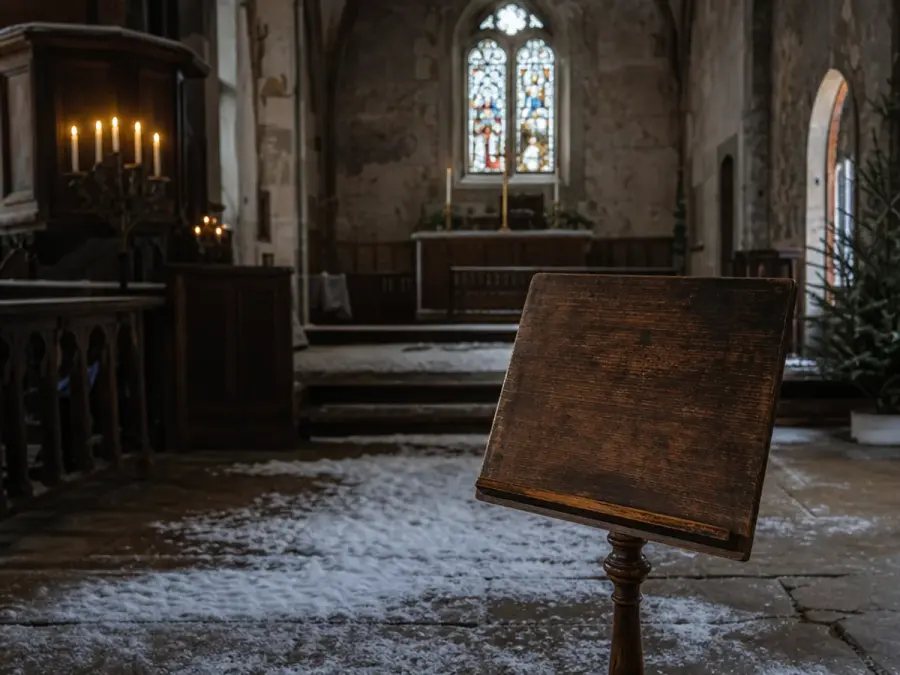
‘O Holy Night’ — introduced in the 1840s — ‘O Holy Night’ — introduced in the 1840s
The French carol began as ‘Minuit, chrétiens,’ with music by Adolphe Adam and words by Placide Cappeau. Its long performance history crosses languages, voice types, and arrangements.
A gallery can discuss that lineage without printing lyrics or treating a modern vocalist’s version as the original song.

‘Jingle Bells’ — published in 1857 — ‘Jingle Bells’ — published in 1857
James Pierpont’s song was published as ‘One Horse Open Sleigh’ in 1857. It was not originally framed exclusively as a Christmas carol, which helps explain how seasonal associations can develop after publication.
Its many recordings should not be collapsed into one play total without a composition-level method.
‘O Little Town of Bethlehem’ — written in 1868 — ‘O Little Town of Bethlehem’ — written in 1868
Phillips Brooks wrote the text after a journey to Bethlehem, and Lewis Redner supplied the tune commonly used in the United States.
Other traditions use a different melody. That split is a useful reminder that a familiar song title may refer to more than one established musical setting.
‘White Christmas’ — introduced in 1942 — ‘White Christmas’ — introduced in 1942
Irving Berlin’s song reached film audiences in ‘Holiday Inn,’ with Bing Crosby’s recording becoming central to its commercial history.
The composition, film performance, original single, and later re-recordings are separate rights and data objects. Sales achievements should not be relabeled as verified lifetime plays.
‘Have Yourself a Merry Little Christmas’ — 1944 — ‘Have Yourself a Merry Little Christmas’ — 1944
The song was introduced by Judy Garland in ‘Meet Me in St. Louis’ and later revised and recorded in multiple forms.
Its history demonstrates why editorial context matters: audiences may know different words or arrangements, but this gallery avoids reproducing either and focuses on documented release lineage.

‘The Christmas Song’ — landmark recording in 1946 — ‘The Christmas Song’ — landmark recording in 1946
Mel Tormé and Robert Wells wrote the standard, and Nat King Cole recorded it more than once.
The 1946 recording is a key date in its history, while later versions can have separate identifiers and totals. Responsible catalog reporting specifies which master recording a number describes.

‘Blue Christmas’ — a country song before the famous cover — ‘Blue Christmas’ — a country song before the famous cover
Billy Hayes and Jay W. Johnson’s song was recorded before Elvis Presley’s 1957 version made it a durable rock-and-roll-era standard.
Naming the earlier lineage prevents the common mistake of assigning authorship to the best-known performer. Recording popularity and songwriting credit are different facts.
‘Jingle Bell Rock’ — 1957 — ‘Jingle Bell Rock’ — 1957
Bobby Helms’s 1957 recording brought rock-and-roll language and rhythm into the seasonal single.
Its endurance includes recurring radio, sales, and streams, but those channels remain separate measurements. The title’s familiarity is not permission to reproduce its lyrics or original artwork.

‘Rockin’ Around the Christmas Tree’ — 1958 — ‘Rockin’ Around the Christmas Tree’ — 1958
Brenda Lee recorded Johnny Marks’s song as a teenager in 1958. Its later returns to charts illustrate catalog rediscovery across generations and platforms.
A current chart peak is a dated achievement, not proof that the work was the most played throughout the decades between release and revival.
‘It’s the Most Wonderful Time of the Year’ — 1963 — ‘It’s the Most Wonderful Time of the Year’ — 1963
Andy Williams introduced the Edward Pola and George Wyle song on a 1963 Christmas album.
Radio recurrence and seasonal playlists keep older recordings in circulation, but playlist placement, broadcasts, and listener-selected streams answer different questions. Any performance claim needs its measurement source.

‘Feliz Navidad’ — 1970 — ‘Feliz Navidad’ — 1970
José Feliciano wrote and recorded this bilingual seasonal song in 1970. Its concise structure and cross-language reach helped it circulate internationally, though reach should be documented with territory-specific sources.
Discussion can respect its cultural position without quoting even a familiar lyric.

‘Last Christmas’ — 1984 — ‘Last Christmas’ — 1984
Wham! released this original pop composition in 1984. Its production, recurring seasonal chart activity, and many covers make it a useful case for separating the original master from the underlying song.
The act’s donation history and video are separate stories requiring their own sources and rights.

‘All I Want for Christmas Is You’ — 1994 — ‘All I Want for Christmas Is You’ — 1994
Mariah Carey and Walter Afanasieff wrote the song for Carey’s 1994 holiday album. Its streaming-era chart performance is remarkable, but it remains a 1990s work with multiple modern consumption signals.
Cite each chart or platform date instead of calling it an unqualified universal number one.

‘Underneath the Tree’ — 2013 — ‘Underneath the Tree’ — 2013
’ Its inclusion shows that a tradition is still being written, not frozen in mid-century standards.
Longevity should be evaluated after enough time, with recording-specific and date-scoped evidence.
Featured galleries







































































































































































































































































































































































































































































